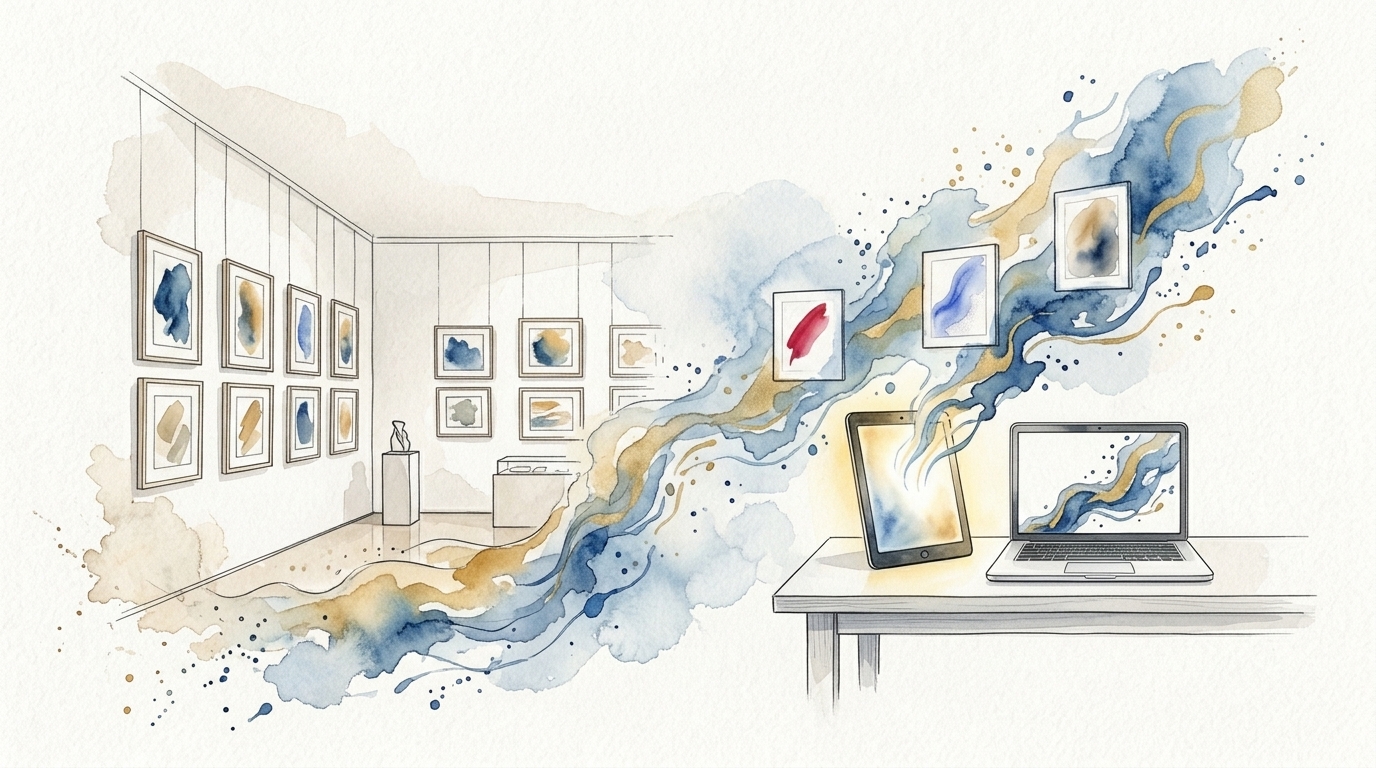
Introduction: A Structural Shift, Not a Trend
The rise of the online art gallery is not a passing technological curiosity. It is a structural transformation of one of the world's oldest and most conservative markets. For centuries, the art world operated on a model built upon physical proximity, personal relationships, and institutional gatekeeping. Acquiring a work of art required walking into a gallery, attending an auction house preview, or having the right connections to a dealer's private inventory. The virtual gallery changed all of that — not by destroying the old model, but by expanding it beyond any previously imaginable geographic, economic, or social boundary.
This article provides a comprehensive retrospective on the benefits of online art galleries and virtual galleries for every stakeholder in the art ecosystem — collectors, artists, galleries, dealers, and art fairs. It traces the early resistance, the accelerants of adoption, and the current state of a market where digital and physical channels have formed a symbiotic, hybrid model. Where possible, we reference industry studies and data points, including the annual Art Basel and UBS Global Art Market Reports, the Hiscox Online Art Trade Reports, and findings from Arts Economics.
A Brief Market Retrospective
The concept of selling art through internet galleries emerged in the late 1990s and early 2000s, but meaningful commercial traction did not materialize until the 2010s. Platforms such as Artnet (founded in 1989, but pivoting to e-commerce later), Artsy (launched in 2012), and Saatchi Art (relaunched in 2014 under Demand Media) began building the infrastructure for digital art transactions. However, the market response was tepid. According to the Hiscox Online Art Trade Report 2013, the total online art market was valued at an estimated $1.57 billion — a fraction of the approximately $65 billion global art market at the time.
Between 2015 and 2019, online art sales grew steadily but remained supplementary. The Art Basel and UBS Global Art Market Report 2020 (authored by Dr. Clare McAndrew) estimated that online sales accounted for approximately 9% of the global market in 2019, reaching roughly $5.9 billion. The infrastructure was being laid — high-resolution photography, secure payment gateways, and logistical partnerships with specialist art shippers — but broad cultural adoption lagged behind.
Then came 2020. The COVID-19 pandemic forced the closure of physical galleries, the cancellation of art fairs, and the indefinite postponement of auction house viewings worldwide. In a matter of weeks, the entire art market was compelled to move online or cease operating entirely. The Art Basel and UBS Global Art Market Report 2021 documented that online sales doubled in 2020, reaching an estimated $12.4 billion — leaping from 9% to roughly 25% of total market transactions. The digital gallery had gone from a convenience to a survival mechanism.
By 2025, the global art market was estimated at $59.6 billion, with online sales stabilizing at approximately 15% to 18% of total transactions. This apparent contraction from the pandemic peak does not indicate a retreat; rather, it reflects the normalization of a hybrid model where online and physical channels coexist and reinforce each other.
The Initial Drawbacks and Market Resistance
In its early stages, the concept of buying fine art online was met with fierce resistance from established institutions and collectors. The art market has historically relied on opacity, exclusivity, and physical presence. Early web-based art galleries faced several distinct hurdles that delayed mainstream adoption for over a decade.
The Tactile Barrier
Art is inherently physical. Collectors and critics argued that flat JPEGs on a screen could not convey the texture of impasto, the scale of a monumental sculpture, or the true luminescence of a glaze. A 2014 survey by the European Fine Art Foundation (TEFAF) found that over 70% of collectors considered physically viewing a work “essential” before purchasing. The digital viewing experience was dismissed as fundamentally incapable of replicating the visceral experience of standing before a masterwork.
Provenance and Trust
High-value art transactions require immense trust. Without a physical dealer to shake hands with, early buyers were concerned about authenticity, condition reports, and the risks of cybercrime. The art market's reliance on personal reputation and word-of-mouth provenance chains meant that an impersonal digital interface felt inherently riskier. Cases of forgery and misrepresentation in early e-commerce further eroded confidence.
The Exclusivity Complex
Traditional galleries relied on the “white cube” mystique and VIP backrooms to cultivate prestige. The exclusivity was not a flaw — it was the product. Democratizing access through an internet art gallery was initially viewed as diluting brand equity and alienating ultra-high-net-worth (UHNW) collectors who valued discretion, scarcity, and the social ritual of private viewings.
Key Insight: The resistance to digital galleries was not primarily technological — it was cultural. The art market's identity was inseparable from its physical rituals. Overcoming this required not just better technology, but a generational shift in collecting behavior and an external catalyst that made physical commerce impossible.
The Broad Adoption by All Market Actors
Despite early hesitation, a combination of shifting demographics, technological advancement, and the unprecedented catalyst of the global pandemic forced a structural reset. Today, adoption of the online gallery model is nearly universal across all major stakeholders.
Artists
Digital platforms granted artists direct access to a global audience, bypassing the traditional gatekeepers — gallery directors, curators, and auction house specialists — who had historically controlled market entry. Artists could self-publish portfolios, build direct collector relationships via social media and dedicated platforms, and retain higher percentages of their sales. The barrier to entry for gaining market visibility dropped dramatically. An emerging painter in Lagos or a sculptor in Buenos Aires could exhibit their work alongside established names from New York and London, reaching collectors who would never have discovered them through traditional channels.
Merchants and Dealers
Mid-tier and independent dealers utilized digital gallery platforms to drastically reduce overhead costs. Prime gallery real estate in art-world capitals — Chelsea in New York, Mayfair in London, Le Marais in Paris — commands rents that can exceed $100 per square foot annually. Add to that the costs of physical inventory insurance, shipping for exhibition rotations, and staffing for gallery hours, and operating a traditional space becomes a significant financial burden. Digital platforms allowed dealers to redirect these savings into acquiring inventory, marketing, and taking risks on emerging talent, all while reaching a wider geographic base without maintaining a physical footprint.
Traditional Galleries
Rather than fighting digital adoption, blue-chip galleries embraced integrated “clicks-and-bricks” models. Mega-galleries such as Gagosian, David Zwirner, Hauser & Wirth, and Pace launched proprietary online galleries and virtual viewing rooms (OVRs) to run in parallel with physical exhibitions. David Zwirner's OVR platform, launched in 2017 and significantly expanded during the pandemic, reportedly generated millions in sales during its first online-only exhibitions. These spaces captured buyers who couldn't fly to an opening, extending the gallery's reach without compromising its physical brand.
Collectors
The demographic of the collector base shifted decisively. According to the Hiscox Online Art Trade Report, the volume of collectors buying art online surged from 38% in 2012 to 78% a decade later. Younger buyers — millennials and Gen Z — who are highly comfortable with e-commerce, embraced the transparency and convenience of digital acquisitions. They brought new expectations: visible pricing, detailed provenance documentation, high-resolution imagery, and seamless checkout experiences. The traditional model of calling a gallery to “inquire about price” felt anachronistic to a generation accustomed to instant e-commerce.
Benefits for Collectors
The integration of online galleries into the mainstream market brings distinct, quantifiable advantages for art buyers that physical spaces alone cannot match.
Global Accessibility
An internet art gallery has no geographic boundaries and never closes. A collector in Tokyo can acquire a piece from an emerging artist in Brooklyn at 3:00 AM local time. A first-generation collector in Johannesburg can browse inventory from Parisian galleries without applying for a visa. Buyers are no longer restricted by geography or gallery opening hours, enabling access to international talent at any time. This vastly expands the total addressable market for both buyers and sellers.
Price Transparency
Traditional galleries often obfuscate prices, requiring personal inquiries that intimidate new buyers. The ritual of asking “How much is this piece?” — and the social dynamics embedded in that exchange — has been identified as the single largest barrier to converting new art collectors. Online platforms pioneered transparent pricing, displaying costs upfront alongside shipping estimates and payment plans. Studies from the Hiscox Online Art Trade Report consistently identify price transparency as the number one factor in converting first-time art buyers. By removing the intimidation barrier, online galleries have significantly expanded the collector base.
Data-Driven Curation
Digital platforms allow merchants to track user behavior — dwell time, click-through rates, saved favorites, and browsing patterns. This data enables highly targeted marketing and algorithmic recommendations that match specific aesthetics to individual collectors. Rather than relying solely on a gallery director's intuition, digital art galleries can surface works that align with a collector's demonstrated preferences, increasing discovery rates and purchase conversion.
Solving the Art Visualisation Challenge Online
One of the most persistent objections to buying art online has always been the inability to see the work in person. Digital galleries have addressed this head-on with a layered approach that, taken together, gives collectors a level of visual information that often surpasses what they would get during a brief gallery visit.
The first layer is comprehensive photography. Leading art marketplaces actively encourage — and in many cases require — sellers to upload multiple high-resolution photographs of each artwork from every angle: front-facing, close-up details of texture and brushwork, side profiles to show depth and canvas edges, and contextual shots showing the piece hung in a real environment. This multi-angle documentation gives buyers a far richer visual understanding of the work than a single exhibition wall view ever could.
Beyond photography, sellers are expected to provide thorough written descriptions: medium, dimensions, materials, technique, framing status, condition, and the artist's own commentary on the work's concept and creation process. This combination of visual and textual detail creates what the industry calls a “complete listing” — a digital equivalent of the condition report that high-end dealers have always provided to serious buyers.
The second layer is interactive 3D visualisation. For sculpture, ceramics, and three-dimensional works, several platforms now offer rotatable 3D viewers that let collectors examine a piece from every angle, zoom into surface details, and understand its spatial presence in a way that flat photography cannot achieve. This technology has been particularly transformative for sculptors and mixed-media artists whose work loses critical dimensionality in traditional photographs.
The third layer is augmented reality placement — commonly called “view on the wall” features. Platforms such as Artmajeur, Saatchi Art, and Artsy allow collectors to point their smartphone camera at a wall in their home and project a true-to-scale, color-accurate rendering of the artwork directly into their living space. This AR preview shows how a painting interacts with the room's lighting, furniture, and proportions, effectively eliminating the guesswork that once made online purchases feel risky.
Finally, to close the remaining confidence gap, most reputable online galleries offer generous free return policies — typically 14 to 30 days, and sometimes longer — allowing collectors to receive the physical artwork, live with it in their space, and return it at no cost if it does not meet expectations. This safety net is essential when purchasing an original, unique artwork that a buyer has never seen in real life. Combined with high-fidelity multi-angle imagery, interactive 3D views, AR wall placement, and detailed descriptions, these return guarantees have transformed the online art purchase from a leap of faith into a well-informed decision backed by a risk-free trial period.
Purchasing Confidence
The cumulative effect of these visualisation tools and buyer protections is measurable. Today, roughly 95% of high-net-worth (HNW) collectors surveyed in the Art Basel and UBS Global Art Market Report 2026 report feeling comfortable purchasing art without viewing it in person first, relying on the high-fidelity imagery, detailed condition reports, and trusted digital infrastructure of established online galleries. This statistic would have been unthinkable a decade ago, when the overwhelming majority insisted on physical inspection.
Benefits for Galleries and Dealers
Business Continuity and Resilience
Internet-based galleries provide critical infrastructure during periods of restricted movement, remaining entirely operational when physical spaces are forced to close. During the COVID-19 pandemic lockdowns of 2020 and 2021, this digital resilience was the primary lifeline that allowed galleries to stay in business and maintain community connectedness without foot traffic. Galleries that had invested in online viewing rooms prior to the pandemic were able to pivot immediately, while those without digital infrastructure scrambled to build it from scratch — in many cases, too late to avoid severe revenue losses.
Expanded Reach Without Overhead
Mid-tier and independent dealers can reach a global audience without the immense overhead costs associated with maintaining prime physical real estate, shipping inventory for exhibition rotations, insuring works in transit, and staffing gallery hours. A digital storefront can be maintained at a fraction of the cost, freeing capital for artist acquisition, marketing, and inventory development. The Art Basel and UBS report consistently finds that galleries with active online sales channels report higher total revenue than those relying exclusively on physical sales.
Extended Exhibition Lifespan
A physical exhibition typically runs for three to six weeks before the works are taken down, packed, and stored. An online viewing room (OVR) or digital gallery preserves the exhibition indefinitely. Collectors can revisit a curated show months — or even years — after the physical works have been packed away, driving long-tail sales long after the opening reception is over. This fundamentally changes the economics of exhibition production, allowing galleries to amortize their curatorial investment over a much longer revenue window.
The “Digital Funnel”
Online galleries serve as entry points for new buyers. The digital environment is a lower-stakes space where first-time collectors can browse, learn, and make their first purchase — often at price points below $5,000 — without the social pressure of a gallery visit. As these collectors grow more comfortable and their budgets expand, they transition to attending physical fairs and flagship gallery spaces for higher-value acquisitions. The web-based gallery acts as the top of the funnel, feeding qualified buyers into the traditional market.
Resilience and Sales Volume
Online sales continue to grow in importance, creating a steady, high-volume income stream that complements the high-value but less frequent transactions of physical sales. While a single work sold at Art Basel might generate six or seven figures, the aggregate of dozens of smaller online transactions per month provides predictable cash flow that sustains gallery operations between major fairs and exhibitions.
Benefits for Artists
Direct Audience Engagement
Digital platforms allow artists to bypass traditional gatekeepers entirely. Rather than waiting for a gallery director to discover their work, artists can build independent followings through dedicated online galleries, personal websites, and social media channels. This direct-to-collector model allows artists to control their narrative, set their own pricing, and retain a significantly higher percentage of each sale compared to the traditional 50/50 gallery commission split.
Democratized Discovery
Emerging artists can exhibit their portfolios globally alongside established names, lowering the barrier to entry for gaining market visibility. A self-taught painter working from a studio apartment can present their work with the same visual quality and professional framing as a blue-chip gallery artist, provided they invest in proper photography and presentation. The digital gallery does not discriminate based on pedigree, gallery representation, or art school credentials — it discriminates based on the quality of the work and the effectiveness of its presentation.
Complementing, Not Replacing, the Traditional Gallery
A core finding of recent market retrospectives — including the Art Basel and UBS Global Art Market Report 2026 — is that online sales have not cannibalized physical galleries. Instead, the two models have formed a symbiotic, hybrid ecosystem. The global art market, estimated at $59.6 billion in 2025, sees online gallery sales accounting for roughly 15% to 18% of total transactions. The remaining 82% to 85% still flows through physical galleries, auction houses, private dealers, and art fairs.
The dynamic works in tandem. The internet art gallery did not destroy the traditional gallery; it saved it from stagnation. By handling high-volume, accessible inventory and democratizing discovery, virtual spaces allow physical galleries to focus on what they do best: producing spectacular, immersive physical exhibitions and cultivating deep relationships within the highest echelons of the market.
The Digital Funnel in Practice
An online gallery often acts as the top of the acquisition funnel. It is a lower-stakes environment where new collectors make their first purchase. As their confidence grows and their collection develops, these buyers transition to attending physical fairs and flagship gallery spaces. The online experience educates, qualifies, and converts; the physical experience deepens relationships and facilitates major acquisitions.
Extending the Exhibition Lifecycle
A physical exhibition might last four weeks. A corresponding digital viewing room preserves the exhibition indefinitely. Collectors who missed the opening can revisit a curated show months later, browse at their own pace, and inquire about available works. This drives long-tail sales long after the physical artwork has been packed into climate-controlled storage. For galleries, this represents a fundamental shift in exhibition economics — the return on curatorial investment is no longer capped by a four-week window.
The Hybrid Reality
HNW collectors remain willing to spend heavily on art, but their behavior has changed. While live art fairs have fully returned to pre-pandemic levels of attendance, data from the Art Basel and UBS report shows that 95% of HNW collectors surveyed still purchase works without viewing them in person first, relying on the trusted digital infrastructure built by galleries during the pandemic years. The physical gallery experience is now augmented by, not dependent on, physical-only engagement.
Key Finding: The online art gallery did not replace the traditional gallery — it expanded the market. By lowering barriers to entry, enabling price transparency, and providing 24/7 global access, virtual galleries grew the total collector base while physical galleries retained their role as the venues for high-touch, high-value transactions.
Art Fairs and the Dual Digital-Physical Model
The evolution of art fairs provides a compelling case study in hybrid adoption. Major fairs — Art Basel (Basel, Miami Beach, Hong Kong, Paris), Frieze (London, New York, Los Angeles, Seoul), and The Armory Show — have increasingly integrated digital tools into their physical events. During the pandemic, Art Basel launched “Online Viewing Rooms” (OVRs) as a substitute for cancelled fairs. These digital editions attracted hundreds of thousands of visitors, generated significant sales, and — crucially — demonstrated that the fair model could function without a physical venue.
Post-pandemic, fairs did not abandon their digital infrastructure. Instead, they adopted a dual model: physical booths remain the centerpiece of the fair experience, but each exhibitor simultaneously maintains an OVR that extends the fair's reach beyond the convention center walls. A collector who cannot attend Art Basel Miami Beach in person can still browse every exhibitor's booth online, request condition reports, and initiate purchases remotely. The physical fair now functions as a high-profile marketing event that drives traffic to both the booth and the online gallery.
This dual model has also democratized fair participation. Smaller galleries that cannot afford the $50,000 to $100,000+ cost of a premium physical booth can participate in digital-only fair programs at a fraction of the cost, gaining exposure to the fair's collector base without the logistical burden of shipping inventory internationally.
Adoption Trends: The Crossover Point
The trajectory of digital gallery adoption relative to traditional physical gallery dominance follows a well-documented pattern. From 2012 through the late 2010s, online sales grew steadily but remained firmly supplementary to the physical market. The pandemic years (2020–2021) served as an inflection point, accelerating adoption by several years. By approximately 2021, the volume of art transactions occurring through digital channels surpassed the volume processed through exclusively physical channels for the first time.
The chart above illustrates this crossover. The blue line represents online gallery sales volume (indexed), which rises from a low base in 2012 and accelerates sharply through the pandemic period. The green line represents traditional physical gallery volume, which starts from a dominant position but declines as digital channels absorb a growing share of transactions. The crossover around 2020–2021 marks the moment when digital became the primary transaction channel by volume — though not by dollar value, where physical sales (driven by ultra-high-end auction lots and blue-chip gallery transactions) continue to dominate.
This distinction is important: online galleries lead in transaction volume, while physical channels lead in transaction value. The two are complementary, not competitive. Sources include aggregated data from the Hiscox Online Art Trade Reports (2013–2023), the Art Basel and UBS Global Art Market Reports (2019–2026), and Arts Economics analysis by Dr. Clare McAndrew.
Conclusion
The benefits of online galleries and virtual art platforms are no longer theoretical. They are documented, measured, and embedded in the operational reality of every major participant in the global art market. For collectors, they provide global access, price transparency, data-driven discovery, and immersive previewing tools. For galleries and dealers, they offer business continuity, expanded reach, extended exhibition lifespans, and a reliable sales funnel. For artists, they provide direct audience engagement and democratized market access.
Critically, the digital art gallery has not displaced the traditional gallery. It has expanded the total market, brought in a new generation of collectors, and created a hybrid ecosystem where physical and digital channels reinforce each other. The galleries that thrive today are those that embrace both — using virtual spaces to cast a wide net and physical spaces to deepen relationships and deliver the irreplaceable experience of standing before a work of art in person.
The art market of 2026 is not online or physical. It is both, simultaneously, and the data shows that this dual model is the most resilient and expansive configuration the market has ever known.