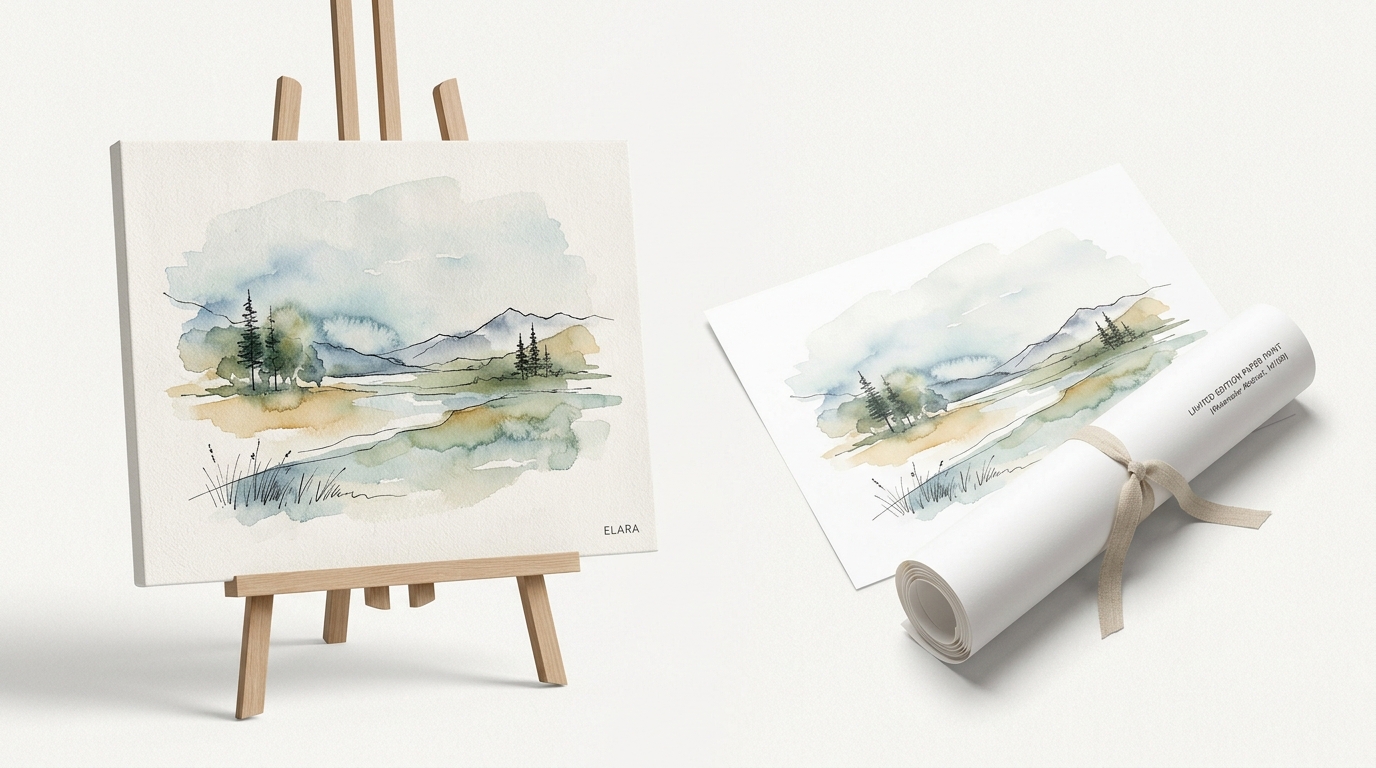
1. Why Offer Fine Art Prints?
Original oil paintings, large sculptures, and detailed mixed-media canvases represent high-end luxury items. While they command premium prices ($1,000 to $10,000+), they sell slowly.
Fine art prints allow you to monetize budget-conscious collectors who love your art style but cannot afford original pieces. Furthermore, selling reproductions creates a passive income stream. Once you photograph your artwork, you can sell hundreds of print copies without doing any extra studio labor.
2. Fine Art Printing Standards: What is Giclée?
Do not sell reproductions printed on standard home inkjet or office laser printers. Collectors will immediately return them. To command premium pricing, your prints must meet the **Giclée standard**:
- Ink Type: Must use pigment-based inks instead of dye-based inks. Pigment inks are highly resistant to UV light and fading, maintaining colors for 100+ years.
- Paper Stock: Prints must be executed on heavy, acid-free archival fine art papers, such as Hahnemühle Photo Rag or Somerset Velvet (minimum weight of 250 gsm).
- Resolution: The source image file must have a minimum resolution of 300 DPI (dots per inch) at the exact output print size.
3. Open Editions vs. Limited Editions
You must decide how to structure the distribution volume of your prints:
Open Editions: You can print and sell an unlimited number of copies. Pricing is lower ($20 to $60 per print), and these perform best on mass marketplaces (e.g., Etsy, Redbubble, Fine Art America).
Limited Editions: You set a strict limit on the number of prints to be produced (e.g., a run of 50 or 100 prints). Once they sell out, the print is retired. Each limited-edition print must be signed and numbered (e.g., `4/50`) by the artist and accompanied by a signed Certificate of Authenticity (COA). Because of their rarity, they command much higher prices ($150 to $500+).
4. Self-Fulfillment vs. Print-on-Demand (POD)
How will you handle printing and shipping?
| Fulfillment Method | Average Margins | Pros & Cons |
|---|---|---|
| Print-on-Demand (POD) Dropshipping | 20% – 35% | Pros: Zero inventory cost, automated order shipping. Cons: Lower margins, no control over packaging quality or custom inserts. |
| Self-Fulfillment (Local Print Shop) | 60% – 80% | Pros: Full quality control, hand-signed/numbered prints, custom packaging. Cons: Requires packaging time, upfront inventory costs. |
💡 Recommendation: Use Print-on-Demand (e.g., Printful or Fine Art America) for affordable open-edition posters, but handle printing locally for your premium limited-edition collections.
Checklist for Launching Prints
As your print collections grow, managing various editions, sizes, and platforms gets complex. Storing your digital files and printing data in OnlineGallery.com keeps your records clean. Coordinate your original canvas listings alongside prints and maintain absolute catalog integrity.