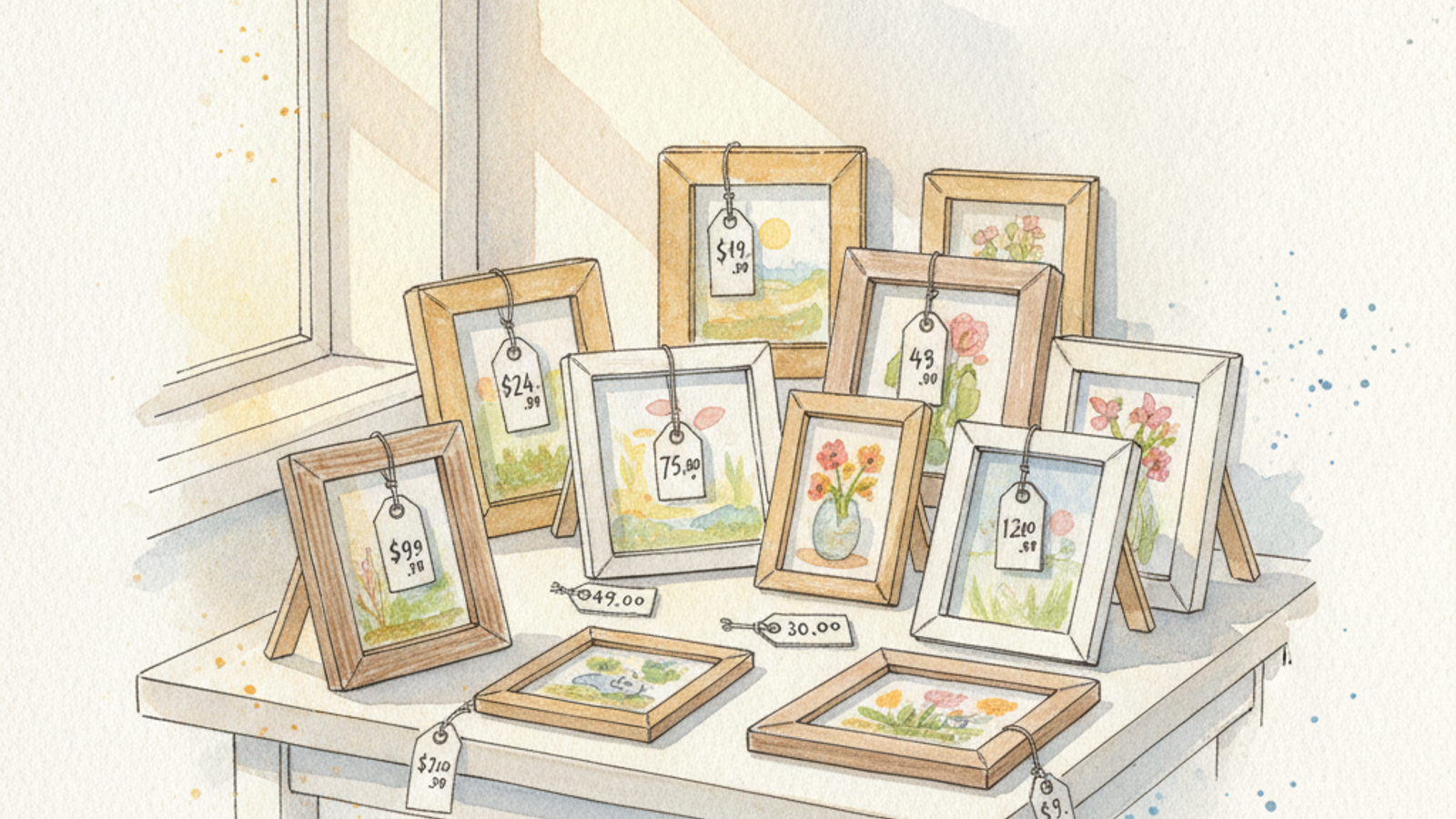
Pricing your artwork isn't just about covering costs and making a profit; it's a powerful psychological tool. Top-selling independent artists on platforms like Etsy and Saatchi Art understand this. They strategically select numbers that influence buyer perception, create a sense of value, and ultimately drive sales. This guide will break down the most effective psychological pricing strategies you can implement today, complete with practical examples tailored for online art sales.
The Subtle Power of Charm Pricing (The "$X.99" Effect)
Charm pricing, where prices end in .99, .95, or .97, is one of the oldest and most effective psychological tactics. The human brain tends to focus on the leftmost digit. So, a $199 item is perceived as significantly cheaper than $200, even though the difference is just one dollar. It creates a subconscious perception of a 'deal' or a 'bargain.'
For artists, this works wonders for more accessible items. On Etsy, use charm pricing for prints, smaller originals, art merchandise (like stickers or cards), and digital downloads. An 8x10 print priced at $49.99 will likely outperform one at $50. Similarly, a small, unframed original piece at $149.95 can attract buyers looking for an affordable entry point into collecting original art.
Even on Saatchi Art, for pieces under $1,000, consider prices like $795 or $995 for small studies or limited edition prints. This can make them feel more attainable to emerging collectors. However, for high-end, investment-worthy originals, avoid charm pricing; it can inadvertently signal discount rather than luxury.
Price Anchoring: Making Your Art Seem More Valuable
Price anchoring capitalizes on the human tendency to rely heavily on the first piece of information (the 'anchor') offered when making decisions. By presenting a higher-priced item first, all subsequent items, even if expensive, will seem more reasonable or affordable by comparison.
On Saatchi Art, strategically feature your most significant, high-value original painting (e.g., $8,000 - $15,000) prominently on your profile or at the top of a collection. Even if it rarely sells, it establishes a high anchor point. Then, when a potential buyer sees your medium-sized originals at $2,000-$4,000 or your limited edition prints at $300-$700, they will perceive these items as more accessible and a better value relative to the anchor.
For Etsy artists offering multiple print sizes or mediums, list the most expensive option first in your variations. For example, if you offer an 8x10 print for $50, a 16x20 print for $120, and a large canvas print for $350, ensure the $350 option is the default or appears first. This anchors the buyer at the highest price, making the $50 and $120 options feel like a much better deal.
Decoy Effect: Guiding Buyers to Your Sweet Spot
The decoy effect involves introducing a third, strategically priced option to make one of the other options appear significantly more attractive. It subtly steers buyers toward your preferred choice.
Consider print pricing on Etsy. If you have two options:
- Option A: 12x16 inch print for $100
- Option B: 16x20 inch print for $180
Now, add a decoy (Option C) if you want to push sales for Option B:
- Option C: 16x20 inch print for $200 (the decoy)
Suddenly, Option B ($180 for 16x20) looks like an incredible deal compared to Option C ($200 for the same size), while still offering a significant upgrade over Option A. This subtly pushes buyers toward your desired mid-range or higher-value option.
Practical Tip: When setting up print variations, consider adding a slightly overpriced, less attractive option (the decoy) to make your target offering seem like a steal. This works best when the decoy is clearly inferior in value for money compared to the option you want to sell.
Prestige Pricing: Signalling Exclusivity with Rounded Numbers
Unlike charm pricing, prestige pricing uses whole, rounded numbers (e.g., $1,000, $5,000, $10,000). This strategy signals luxury, exclusivity, and high quality. Buyers associate round numbers with a premium experience, where the slight monetary difference is less important than the perceived status or craftsmanship.
This strategy is particularly effective on platforms like Saatchi Art, where collectors are often looking for investment pieces. Pricing an original painting at $2,500 or $4,000 aligns with a luxury brand perception much better than $2,499.99 or $3,995. The clean, rounded figures communicate confidence in your artwork's value and artistry.
Use prestige pricing for unique original paintings, large-scale works, highly limited edition prints (e.g., an edition of 5), or commissioned pieces. If your target demographic is serious collectors, this approach reinforces the high-end nature of your brand.
The Bundle Advantage: Increasing Perceived Value
Bundling involves offering multiple items as a package deal. When priced correctly, a bundle makes the overall offer seem more attractive than buying each item individually, even if the total price isn't significantly lower. It adds convenience and perceived savings.
On Etsy, consider these bundles:
- A popular 8x10 print + a complementary simple frame for $75. Sold separately, the print might be $45 and the frame $35. The bundle saves the buyer effort and a few dollars, making it an easy 'yes.'
- A 'Gift Set' including a small original painting, a branded bookmark, and a personalized artist statement, all beautifully packaged for $160. The perceived value of the cohesive gift experience often outweighs the sum of its parts.
For Saatchi Art or direct sales to higher-end clients, create a 'Collector's Package.' This could include an original artwork, a signed certificate of authenticity, a high-quality artist's book or catalog featuring your work, and perhaps an invitation for a virtual studio visit. The added elements justify a premium price and create a more enriching acquisition experience.
Scarcity & Urgency: Driving Action Ethically
Humans are wired to desire what is scarce. Creating a perception of limited availability or a deadline can significantly boost conversion rates. This isn't about manipulation; it's about highlighting genuine rarity and encouraging timely decisions.
How to apply this:
- Limited Editions: For prints, clearly state the edition size (e.g., "Edition of 50" on Etsy or Saatchi Art). As prints sell, update the listing with phrases like "Only 12 Remaining!" This is a powerful motivator. For originals, emphasize their unique nature: "One-of-a-kind original painting."
- Timed Releases/Sales: Announce special collections or print releases available only for a limited time (e.g., "Available until October 31st"). Use sparingly to maintain impact. A "24-Hour Flash Sale on Select 5x7 Prints" can generate immediate interest on Etsy.
You can also tie scarcity into pricing: some artists increase the price of prints as an edition dwindles (e.g., prints 1-10 at $150, prints 11-20 at $175). This rewards early buyers and creates an incentive to act quickly.
The "Rule of Three" for Clear Choices
When presenting options, offering three distinct tiers or choices is often ideal. Too few can feel restrictive, while too many can lead to decision paralysis. The middle option, or the 'better' choice, frequently becomes the most popular.
For prints on Etsy, structure your sizes and prices as 'Good, Better, Best':
- Good: Smallest size (e.g., 8x10 inch) - $50
- Better: Medium size (e.g., 11x14 inch) - $90 (often perceived as the best value)
- Best: Largest size (e.g., 16x20 inch) - $150 (premium option)
This clearly defined structure helps buyers navigate choices and makes the 'Better' option, which often provides the optimal balance of size and price, highly attractive. Similarly, for small originals or studies on Saatchi Art, you might offer unframed for $200, framed for $350, and a slightly larger framed piece for $600. The $350 option will likely be your bestseller.
Mastering psychological pricing isn't about tricking your buyers; it's about understanding how people perceive value and making your artwork's worth clear and appealing. By strategically applying these techniques on Etsy and Saatchi Art, you can enhance buyer experience, increase perceived value, and ultimately drive more consistent sales. Experiment with these strategies, track your results, and refine your approach to find what resonates best with your audience. Your art deserves to be seen and sold!
Show Your Work to the World
A professional online gallery is the first thing buyers and licensing partners want to see. Build yours on OnlineGallery — free, no commission.
Create Your Gallery Free